Windows & Doors · October 21, 2026 · 8 min read
Window Replacement Title 24 Rules: What Los Angeles Homeowners Need to Know




Most Los Angeles homeowners first hear about window replacement Title 24 rules when a contractor mentions energy forms or an inspector asks about the stickers on the glass. California's energy code, Title 24 Part 6, applies to replacement windows, not just new homes. That affects which products you can buy, how the job is permitted, and what happens at final inspection.
We have been replacing windows across the [San Fernando Valley](/locations/san-fernando-valley) for more than 15 years, from 1950s ranch houses in Woodland Hills with original single-pane aluminum sliders to 1980s stucco tracts in Simi Valley. This guide covers the parts that actually change your project: U-factor and SHGC, the two compliance paths, retrofit vs new-construction frames, and the inspector's checklist.
Why Title 24 Applies and When You Need a Permit
Title 24 treats a window swap as an alteration. When you replace a window, the new unit generally has to meet the current energy standards for your climate zone, even if the house was built decades before the code existed. You cannot simply match the old single-pane glass.
Most of the San Fernando Valley, including Woodland Hills, Tarzana, and Encino, sits in California Climate Zone 9, a hot inland zone. Areas closer to the coast fall in zones 6 and 8. Your zone sets the maximum U-factor and SHGC your windows can have, so it is the first thing your contractor should confirm.
A replacement window permit in Los Angeles is usually required as well. In the City of Los Angeles, LADBS often handles a same-size window swap as an express permit without full plan check. Changing an opening size, adding a window, or cutting in a sliding door is different, since that typically means structural review for a new header. Pasadena, Thousand Oaks, Santa Clarita, and other cities run their own building departments with their own process.
U-Factor and SHGC Basics for California Windows
Every window sold for California use carries a National Fenestration Rating Council (NFRC) label. Two numbers on that label decide whether a product meets Title 24 window requirements, and two more are worth reading.
- U-factor: how fast heat moves through the whole window, frame included. Lower is better. A typical dual-pane low-E window for our area rates around 0.30 or lower, while an old single-pane aluminum slider can be above 1.0.
- SHGC (solar heat gain coefficient): how much of the sun's heat passes through, on a scale of 0 to 1. Lower means less heat gain, which matters on west- and south-facing Valley walls.
- Visible transmittance (VT): how much daylight comes through. It is not a pass-fail number, but check it so low-SHGC glass does not make rooms feel dim.
- Air leakage: how much air passes through the closed unit. Lower numbers mean a tighter window.
Most Los Angeles-area climate zones have limits on both U-factor and SHGC. Quality vinyl and fiberglass windows sold in Southern California usually meet them with standard low-E glass. Homeowners get caught with specialty products: aluminum frames without a thermal break, some wood windows, large folding door systems, and decorative glass.
The rating covers the whole unit. A strong glass package in a poorly insulated frame can still miss the target, so compare the NFRC numbers for U-factor SHGC California windows, not just the glass specs on a brochure.
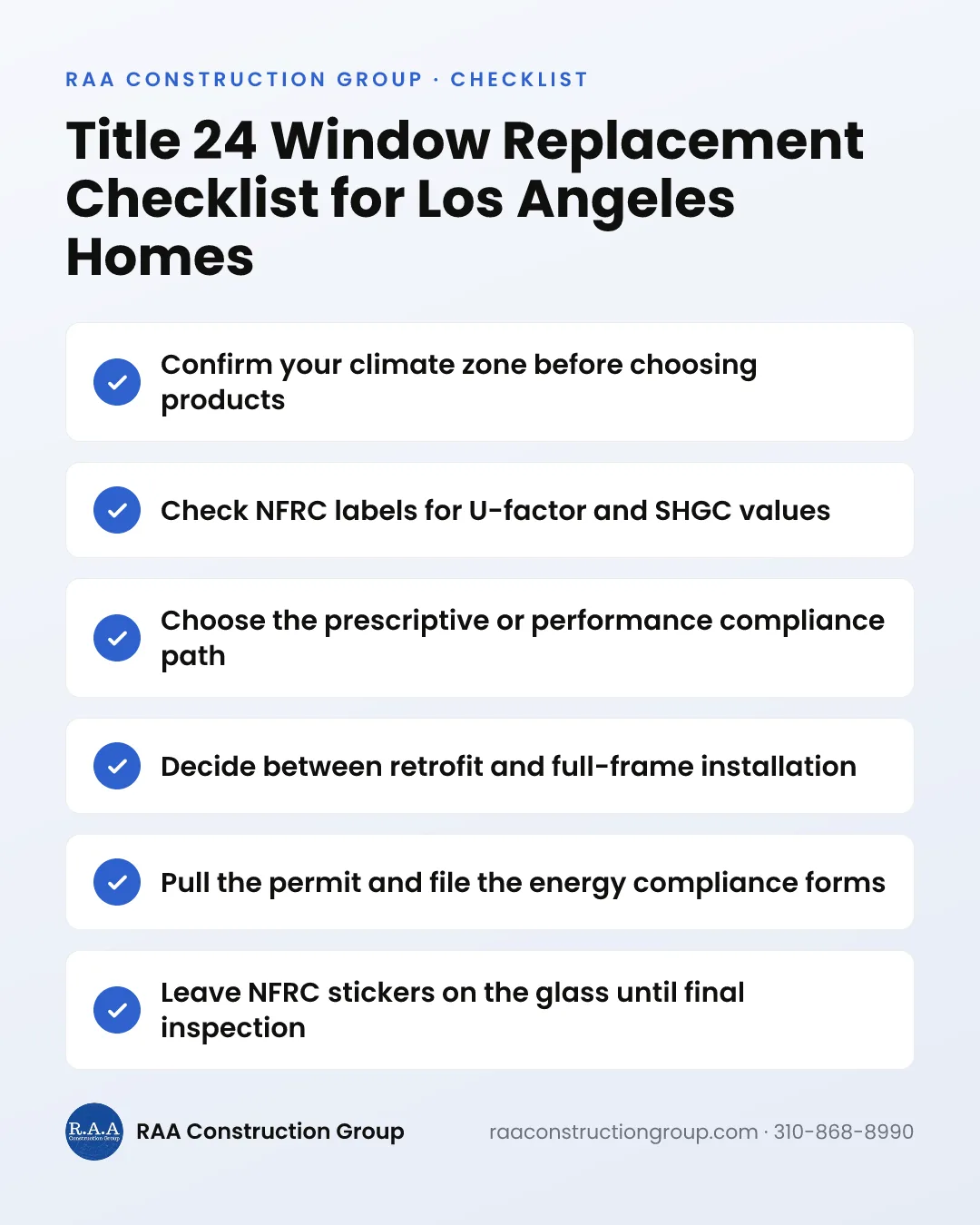
How Window Replacement Title 24 Compliance Works: Prescriptive vs Performance
There are two ways to show compliance. The one you use affects cost, schedule, and which products are on the table.
- Prescriptive path: every new window meets the maximum U-factor and SHGC for your climate zone. The products are listed on a certificate of compliance (CF1R), and the inspector checks the labels against it. This covers the large majority of window-only projects we do.
- Performance path: an energy consultant models the home in state-approved software and compares it to a code baseline. You can trade off, for example, a large aluminum multi-slide door with a higher U-factor against better windows elsewhere or other efficiency upgrades.
The performance path adds a modeling fee and some time before the permit, but it is what lets you use a product the prescriptive limits would reject. It is also common when windows are part of a bigger project, such as an addition or a garage conversion or ADU, since that work is being modeled anyway.
Lock in your compliance path before you order. Custom windows often take several weeks to arrive, and learning that a product misses the prescriptive numbers after it ships is an expensive problem.
After installation, the installer signs an installation certificate (CF2R) confirming that what went in matches what was documented.
Retrofit vs New-Construction Frames: Why the Choice Matters
We see this on Valley homes built in the 1950s and 60s: the original aluminum windows have nailing fins buried behind the stucco. That leaves two installation methods, and the choice affects cost, appearance, and long-term water protection more than it affects Title 24.
- Retrofit (insert) frames: the old sash and glass come out, the old frame stays, and the new window sets inside it with a flush fin that covers the old frame. No stucco cutting and less mess. You lose a little glass area, and the weather seal depends on the old frame and the sealant.
- New-construction (full-frame) installation: the stucco is cut back around each opening, the old frame is removed, and the new window is nailed in and flashed into the weather-resistive barrier. The stucco is then patched and painted. It costs more and takes longer, but you can see and repair hidden rot or termite damage.
Both methods can meet Title 24, because compliance is based on the window's NFRC rating. Retrofit works well when the existing frames are sound, square, and not leaking. Full-frame makes sense if you see water stains under sills, soft framing, or you are changing opening sizes or repainting the stucco anyway.
What the Inspector Checks on a Window Replacement
A window final is usually quick when the paperwork is in order. In our projects, inspectors typically look at the following.
- NFRC labels on each window that match the U-factor and SHGC on the compliance forms
- Signed energy compliance documents available on site
- Tempered safety glass in hazardous locations, such as beside doors, near tubs and showers, and large panes close to the floor
- Bedroom egress, meaning the replacement should not shrink the clear opening of an emergency escape window
- Working smoke and carbon monoxide alarms, which many inspectors confirm on permitted alterations
- Flashing on full-frame installs, sometimes before the stucco patch is closed
Leave the temporary NFRC stickers on the glass until the inspector signs off. Peeling them early is one of the most common reasons we see a window final get delayed.
Fire Zones, Hillsides, and HOA Approval
If your home is in a Very High Fire Hazard Severity Zone, which covers much of Calabasas, Agoura Hills, and hillside neighborhoods in Woodland Hills, Tarzana, and Encino, windows must also meet Chapter 7A ignition-resistant construction requirements. In practice that usually means dual-pane units with at least one tempered pane, or a fire-rated assembly.
These rules sit on top of Title 24, so the window needs both the right energy numbers and the right glass. Many Southern California product lines offer a tempered option that covers both. If you live in Calabasas or a nearby hillside area, confirm your fire zone status before you price windows.
HOA communities, common in Calabasas, Thousand Oaks, and parts of Santa Clarita, may also require architectural approval for frame color, grid pattern, or material. Build that review into your timeline, since it often has to happen before the permit.
Typical Costs and How to Plan Your Window Project
These are typical Los Angeles-area ranges that vary with size, product, and site conditions. Use them for planning, not as a quote.
- Retrofit vinyl window, installed: about $700 to $1,500 per opening
- Full-frame installation with stucco patch: about $1,400 to $3,000 or more per opening
- Fiberglass or wood-clad windows: usually noticeably more than comparable vinyl
- Sliding patio door: about $3,000 to $8,000, with large multi-slide or folding systems often $12,000 to $35,000 or more
A typical Valley home with 15 to 20 windows often lands between $15,000 and $45,000, depending on these choices. Here is the sequence we follow.
- 1Measure openings and assess frame condition on site
- 2Choose products and confirm NFRC numbers for your climate zone
- 3Prepare the energy compliance forms and pull the permit
- 4Order windows and schedule around lead times
- 5Install, flash, seal, patch stucco, and paint
- 6Pass final inspection, then remove the stickers
Our windows and doors team handles Title 24 calcs, the permit, installation, stucco patch, and final inspection under one fixed-price proposal, backed by a one-year workmanship warranty. To get real numbers for your home, schedule a free on-site estimate.
Get Title 24-Compliant Windows Installed Right the First Time
We handle energy calcs, permits, installation, and final inspection with a fixed-price proposal. Call 310-868-8990 or book a free on-site consultation.
Schedule a Free EstimateFAQ