Decks, Patios & Outdoor Living · Thousand Oaks · October 28, 2026 · 8 min read
Composite vs Wood Deck in Thousand Oaks: Sun, Heat, and Fire Ratings




The composite vs wood deck decision looks different in Thousand Oaks than it does in a catalog. Your deck has to handle long dry summers, strong afternoon sun, Santa Ana winds, and, on many lots near open space, California's wildfire building rules. A board that looks great in a showroom can be too hot to walk on in August or may not be allowed in your fire zone at all.
We have built and rebuilt decks across the Conejo Valley, from 1970s tract homes in central Thousand Oaks to hillside estates in North Ranch. This guide covers how each material handles heat, what Wildland-Urban Interface (WUI) rules require, what upkeep really costs over 15 years, and how to tell whether a quote is complete.
Composite vs Wood Deck: How Each Handles Conejo Valley Sun and Heat
Thousand Oaks summers bring many afternoons in the 90s and occasional heat waves above 100, with low humidity and intense UV. That combination is hard on any exterior surface, but it affects wood and composite in different ways.
Wood stays relatively comfortable underfoot, but the sun breaks down its surface fibers. Unsealed redwood or cedar turns gray within a season or two on a south or west exposure, and dry Santa Ana winds speed up checking, cupping, and splitting. Fasteners can loosen as boards shrink.
Composite deck heat is the most common complaint we hear. Capped composite boards, especially dark browns and grays, absorb a lot of heat and can be uncomfortable barefoot on a summer afternoon. Composite also expands and contracts lengthwise with temperature, so gapping at board ends has to follow the manufacturer's instructions closely.
- Choose lighter colors for decks with full afternoon sun
- Ask about heat-mitigating product lines and the manufacturer's published surface temperature data
- Consider a pergola or shade structure over the main seating area
- Use picture-frame borders to hide end gaps and manage expansion
- Keep pool decks and play areas in the lightest tone you can live with
Before you commit to a color, leave a sample board in direct sun at your house for an afternoon and touch it at 3 p.m. It tells you more than any brochure.
WUI Deck Requirements in California: What Fire Zones Change
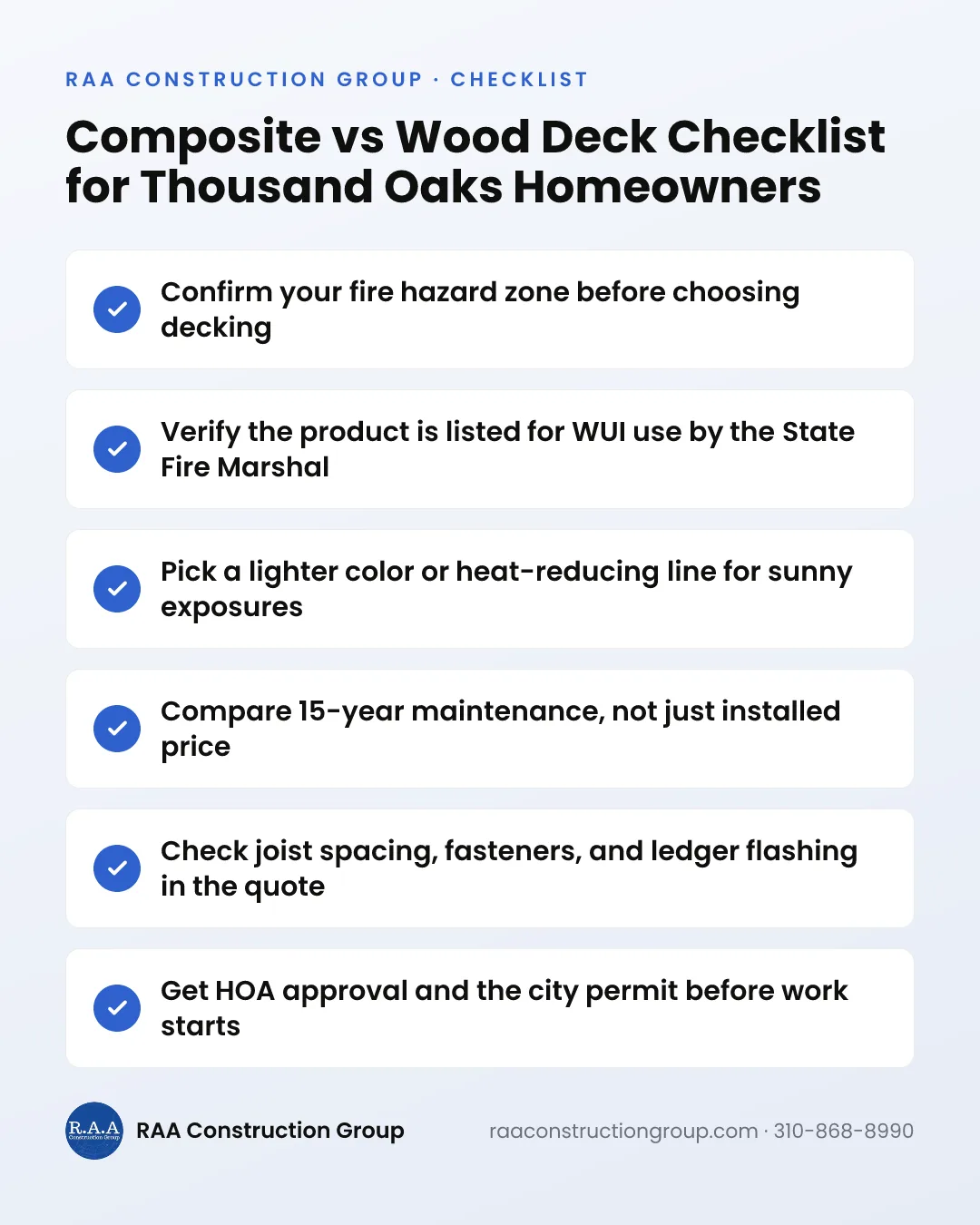
Many Thousand Oaks neighborhoods that border open space, including parts of North Ranch and other hillside areas, fall within Very High Fire Hazard Severity Zones. In those areas, new decks and deck replacements must follow Chapter 7A of the California Building Code, which covers ignition-resistant construction in the Wildland-Urban Interface.
In practical terms, WUI deck requirements in California mean your walking surface has to be an approved material, not just any board. Approved paths generally include noncombustible materials, ignition-resistant or exterior fire-retardant-treated wood, and specific products that have passed the state's fire performance testing.
- Some composite and PVC lines are listed for WUI use, but many are not, even from the same brand
- Exterior fire-retardant-treated wood is an option, at a higher material cost than standard lumber
- Certain dense tropical hardwoods have been tested and listed
- Standard pressure-treated pine, cedar, and untreated redwood typically do not qualify on their own
- A Class A or Class B flame spread rating alone does not prove WUI compliance
The safest approach is to confirm the exact product and color appear on the California State Fire Marshal's building materials listing for WUI use, then keep that documentation for plan check. Design matters too: keep the area under the deck clear of stored items and leaves, use metal flashing where the deck meets the house, and consider noncombustible surfaces in the first few feet next to your walls. California is developing ember-resistant rules for the zone closest to homes, so ask your contractor about current status. Our roof replacement and fire season guide covers related ember-resistance details for the rest of your house.
Deck Maintenance Cost Over 15 Years
Installed price is only part of the picture. Over 15 years in Conejo Valley sun, maintenance often closes much of the gap between wood and composite. The figures below are typical Los Angeles-area ranges for a deck of roughly 400 square feet and vary by scope and site. They are not quotes.
- Pressure-treated framing with redwood or cedar decking: often about $45 to $75 per square foot installed
- Capped composite or PVC decking: often about $60 to $100 per square foot installed
- WUI-listed composite, fire-retardant-treated wood, or listed hardwood: often about $70 to $120 or more per square foot installed
Wood in full sun usually needs cleaning and a penetrating sealer every one to two years. Paying a pro each time commonly runs $1,000 to $2,000 for a deck this size, so over 15 years you may spend $7,000 to $14,000 or more, plus replacing split boards and loose fasteners. Skip the sealing and you may be replacing decking around year 10 to 12.
Composite needs a wash once or twice a year and occasional spot cleaning for grease or pollen. Many homeowners do it themselves with a soft brush and mild soap. The bigger long-term costs are the same for both materials: framing, stairs, and railings, which is why the substructure deserves as much attention as the boards you see.
Choosing a Wood Option That Survives the Conejo Valley
If you prefer real wood and your lot is outside a high fire hazard zone, species and finish matter more than people expect. We see the most problems on decks where good boards were installed with the wrong fasteners or never sealed after the first year.
- Redwood: warm color, stable, naturally resistant to decay; plan on regular sealing to hold color
- Western red cedar: lighter and softer, dents more easily, good for low-traffic areas
- Pressure-treated pine: lowest cost, best used for framing rather than visible decking
- Tropical hardwoods such as ipe: very dense and long-lasting, harder to install, and some species carry WUI listings
For framing, most of our decks use pressure-treated lumber with coated or stainless hardware rated for treated wood, even when the surface is composite. Joist tape on top of the framing helps it last as long as the composite boards above it.
Permits, HOAs, and the City of Thousand Oaks
Permits in Thousand Oaks are issued by the city's building department, not LADBS. Small, low, freestanding decks may be exempt, but decks attached to the house, raised more than about 30 inches above grade, or serving a door generally need a permit. Confirm your specific project with the city before you design around an exemption.
If your home is in an HOA community, such as many tracts in North Ranch and Lynn Ranch, plan for architectural review before the city submittal. HOAs often have rules on colors, railing styles, and visibility from the street. Adding a solid roof over the deck can trigger more requirements, which we cover in our covered patio permit guide.
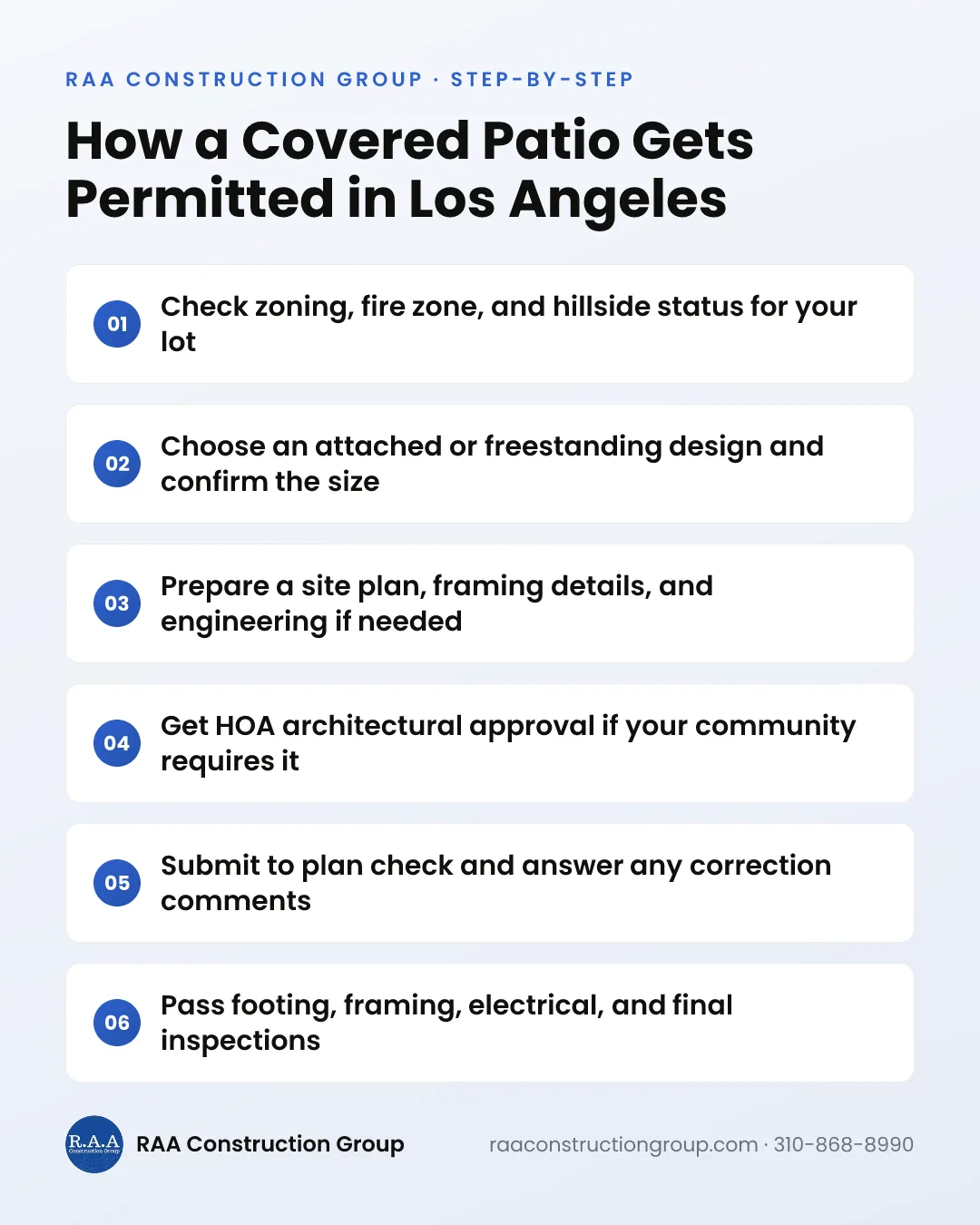
- 1Confirm your fire hazard zone and any HOA rules
- 2Select a decking product and gather its WUI listing if required
- 3Prepare drawings and, for elevated or hillside decks, structural engineering
- 4Submit to the HOA, then to the city's building department
- 5Build with inspections at footings, framing, and final
Our Thousand Oaks team works with the city's planning division and inspection schedule regularly, which helps keep the sequence moving.
What a Fair Quote From a Thousand Oaks Deck Builder Includes
Two deck quotes can differ by thousands of dollars because one leaves out half the job. A complete quote from a Thousand Oaks deck builder should spell out the parts you cannot see once the boards are down.
- Exact decking product line, color, and whether it is WUI listed
- Footing size, depth, and count, plus post and beam sizes
- Joist size and spacing, typically 16 inches on center or 12 inches for diagonal patterns
- Ledger attachment method and flashing against the house
- Fastener type, hidden clips or face screws, and stainless or coated hardware
- Railings, stairs, fascia, and lighting as line items
- Demolition and haul-away of the old deck
- Permits, engineering, and HOA submittal support
- Written workmanship warranty and the manufacturer's material warranty
If a quote says only 'composite decking, 400 sq ft' with a single price, ask for the framing specs and product name in writing before you compare it with anyone else.
In our projects, we provide fixed-price proposals with these items listed, backed by a one-year workmanship warranty and our CSLB license #1047380. You can see the full scope on our decks and patios service page.
Which Material We Usually Recommend, and When
There is no single right answer, but after 15+ years of building outdoor spaces, patterns are clear. Your fire zone usually narrows the choice first, then sun exposure and how much upkeep you will actually do.
- Hillside or open-space lot in a fire zone: WUI-listed composite or PVC in a light color, or a listed hardwood
- Full afternoon sun and kids or pets barefoot: light-colored composite under partial shade, or redwood you are willing to seal
- Low budget and willing to maintain: redwood decking on treated framing
- Selling within a few years: mid-range composite in a neutral color
If you are weighing options for your home, schedule a free on-site consultation and we will check your fire zone, measure sun exposure, and price both materials side by side.
Get a side-by-side composite and wood deck proposal
We will check your fire zone, sun exposure, and HOA rules, then give you a fixed-price proposal for both materials. Call 310-868-8990 or book online.
Schedule a Free EstimateFAQ