Garage Conversions & ADUs · November 10, 2026 · 8 min read
ADU Approval Timeline Los Angeles: How Long Plan Check Really Takes, Step by Step



If you are planning a backyard unit or garage conversion, the first question after cost is usually time. The honest ADU approval timeline Los Angeles homeowners face runs from a few months for a simple conversion to the better part of a year for a hillside detached unit, and that is before construction starts. Most of that variation comes from steps you can control.
We have guided ADUs through LADBS and neighboring building departments across the San Fernando Valley and Ventura County for more than 15 years. Below is the full sequence, from the first zoning check to the certificate of occupancy, with realistic ranges for each stage and the specific things that add or remove weeks.
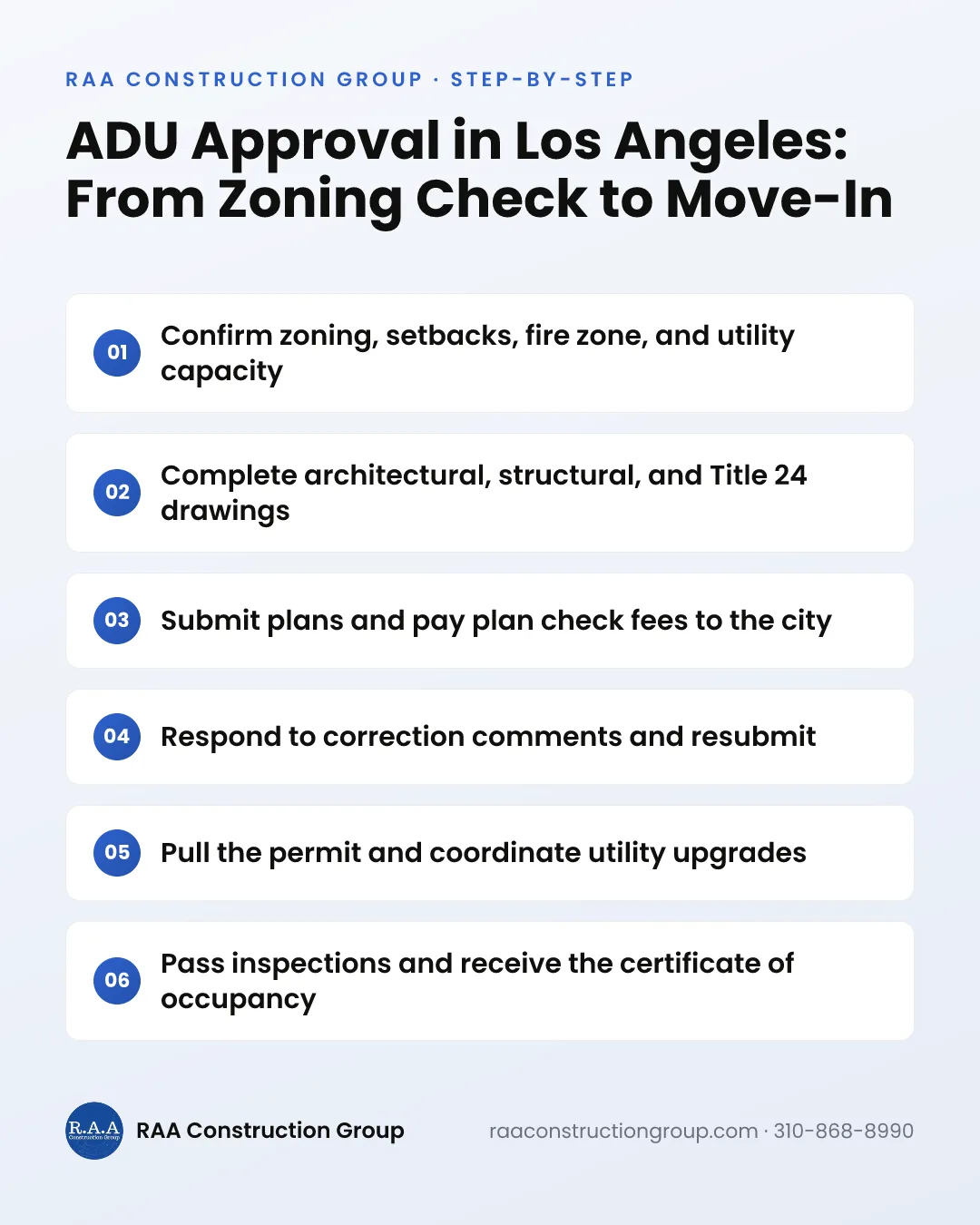
The ADU Approval Timeline Los Angeles Homeowners Should Plan Around
Think of approval as six stages, some of which overlap. These are typical Los Angeles-area ranges for a standard lot. Your project may move faster or slower depending on scope, site conditions, and how busy the department is.
- Feasibility and zoning review: 1 to 3 weeks
- Design, structural engineering, and Title 24 energy calcs: 4 to 10 weeks
- Plan check, including one or two correction cycles: 6 to 16 weeks
- Permit issuance and utility coordination: 2 to 8 weeks, often overlapping
- Construction with inspections: 4 to 6 months for a garage conversion, 6 to 10 months for a detached ADU
- Final inspection and certificate of occupancy: 1 to 3 weeks
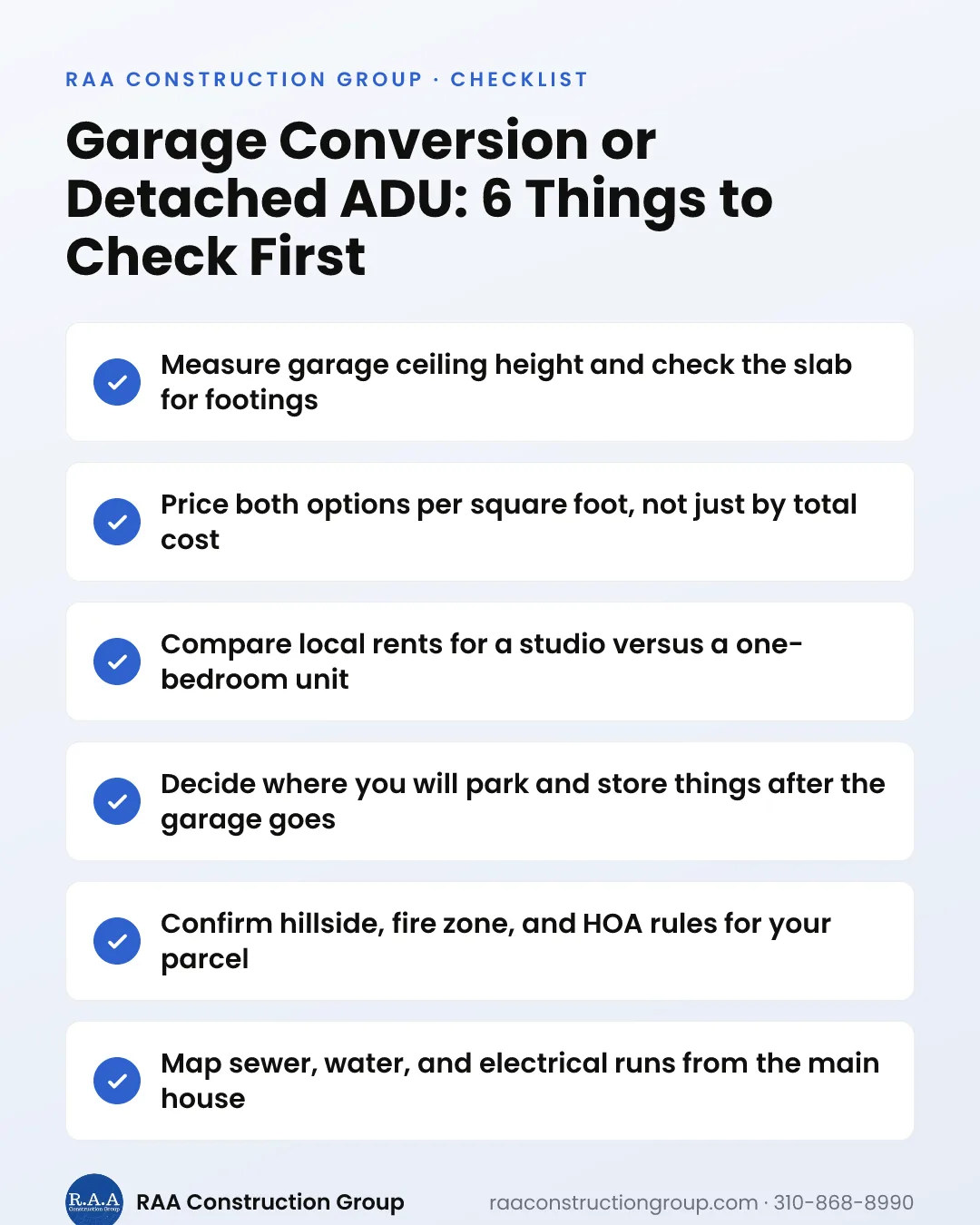
Add it up and a straightforward garage conversion often goes from first meeting to move-in in roughly 8 to 12 months. A new detached unit commonly lands in the 12 to 18 month range. If you are still choosing a type, our comparison of a garage conversion vs detached ADU covers the trade-offs, and our guide to ADU costs in the San Fernando Valley covers budget.
Step 1: Feasibility and Zoning Check Before You Design
This is the cheapest stage and the one people most want to skip. A few hours of research now prevents a redesign after plan check comments come back.
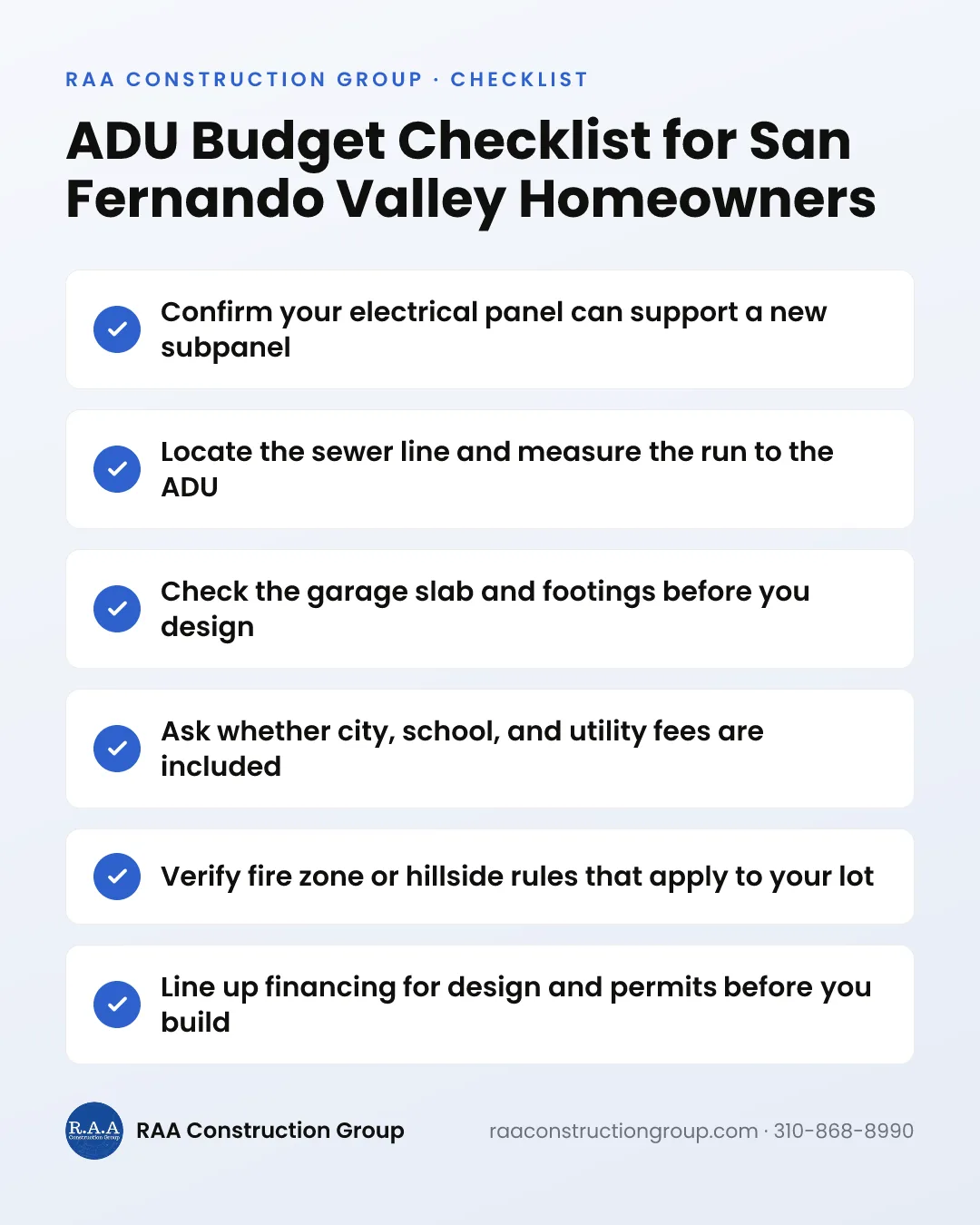
We start by pulling the parcel's zoning and overlay information and checking for conditions that change the drawings:
- Hillside ordinance areas, common on hillside streets in Encino, Sherman Oaks, and Woodland Hills, which can add grading and fire access review
- Very High Fire Hazard Severity Zones, where Chapter 7A ignition-resistant construction applies to the ADU
- Easements, overhead power lines, and protected trees that limit where the unit can sit
- Sewer lateral location and depth, and whether the main electrical panel can support another unit
- HOA rules, which may require architectural review on a separate track
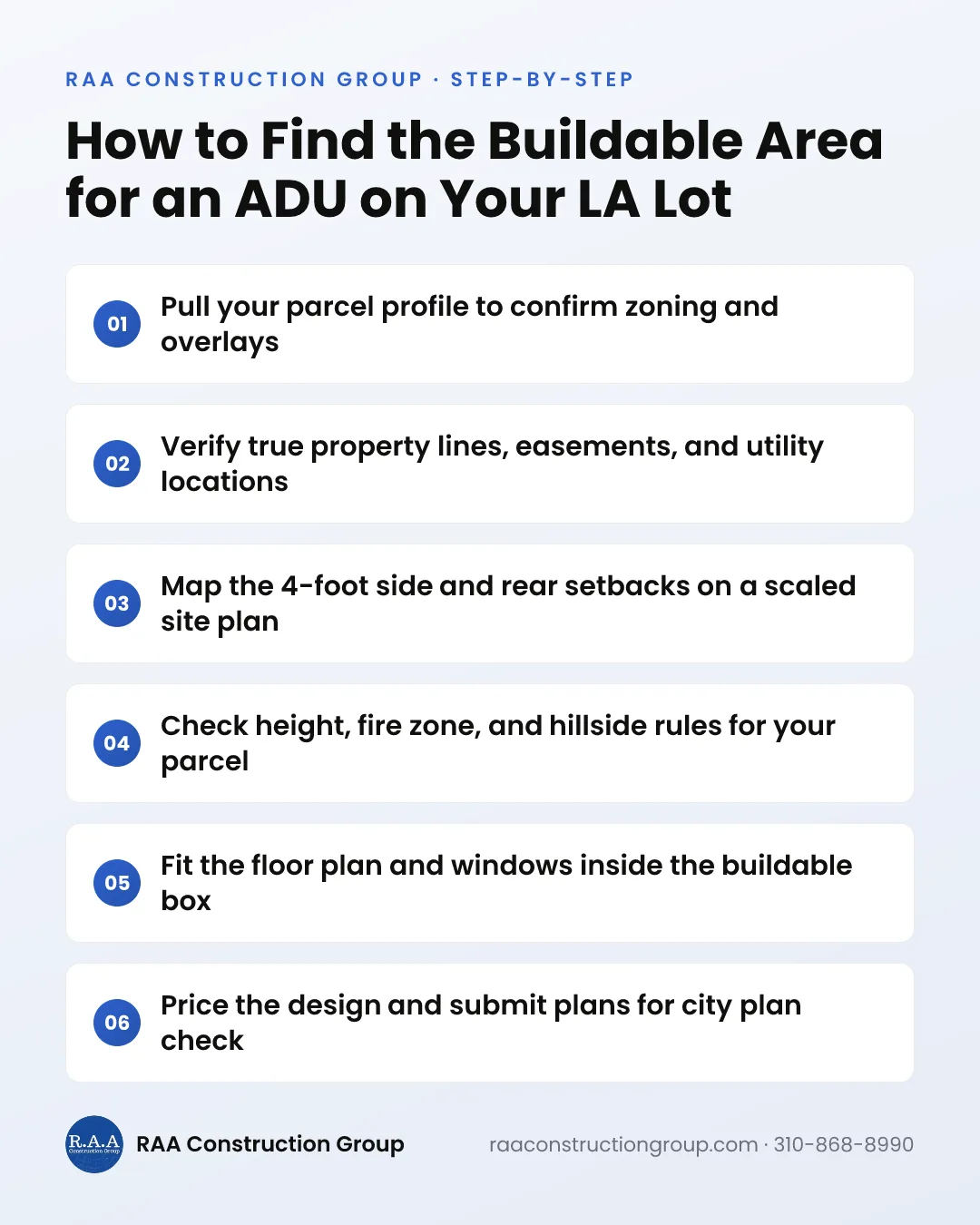
State law allows most detached ADUs with 4-foot side and rear setbacks, but your lot's specifics still matter. Our guide to ADU setback rules in Los Angeles goes deeper on what fits.
Step 2: Drawings, Structural Engineering, and Title 24
A complete ADU plan set typically includes a site plan, floor plan, elevations, sections, foundation and framing plans, structural calculations, electrical and plumbing layouts, and Title 24 energy compliance documents. Title 24 sets the insulation, window, and HVAC efficiency the unit must meet, and it determines whether a new detached unit needs solar.
Garage conversions add a wrinkle: the existing slab, walls, and foundation have to be evaluated. On Valley homes built in the 1950s and 60s, we often find slabs without a vapor barrier and stem walls that need reinforcement, and that work has to show up on the drawings.
Design usually takes 4 to 10 weeks. The biggest variable is decision speed. Layout, kitchen size, and window placement settled early keep the drafter from revising the set three times.
Step 3: LADBS ADU Plan Check and the 60-Day Clock
In the City of Los Angeles, plans go to LADBS for plan check. Depending on the site, other agencies may also review, such as fire, sanitation for the sewer connection, or public works if you are working in the street. In Pasadena, Thousand Oaks, Simi Valley, Santa Clarita, and other cities, the city's building department runs its own version of this process.
California law requires the local agency to approve or deny a complete ADU application within 60 days. Two caveats matter. The clock applies to a complete application, and time you spend answering corrections generally does not count against the city. The rule protects you from open-ended delays, but it does not mean a permit 60 days after submittal.
LADBS also offers options that can shorten review, including expedited plan check for an added fee and pre-approved standard ADU plans. Standard plans can save design and review time, but only if the design fits your lot without major changes.
ADU Corrections Plan Check: Why Cycles Happen and How to Shorten Them
Almost every ADU gets a correction letter, and that is normal. What matters is how many rounds you go through, because each resubmittal sends your plans back into a reviewer's queue.
The comments we see most often on ADU corrections plan check letters:
- Setback or building separation dimensions missing or unclear on the site plan
- Structural calculations that do not match the framing plan
- Title 24 forms that do not match the window schedule or HVAC specs
- Sewer connection details, especially for units behind the main house
- Fire access or sprinkler questions on long, narrow, or hillside lots
- Electrical load calculations showing the existing service is undersized
A well-coordinated set usually clears in one or two rounds. A rushed set can take four. Since each round can add a few weeks, the gap between a clean submittal and a sloppy one is often two to three months.
Ask your designer to answer every correction on a numbered response sheet that points to the exact sheet and detail where the fix appears. Reviewers move faster when they do not have to hunt.
Utilities: The Step That Quietly Adds Months
Utility work causes the most surprise delays we see, because it runs on the utility's schedule, not the building department's.
- Electrical: if your service cannot carry the added load, LADWP or Southern California Edison may need to approve an upgrade, which can take several weeks to a few months.
- Sewer: a detached ADU often needs a new or upsized lateral, and a long run to the street can trigger extra review.
- Gas: many owners go all-electric to avoid a new gas line, which can also make Title 24 compliance easier.
- Water: added fixtures may require a larger meter or supply line.
The fix is sequencing. We submit utility applications as early as the drawings allow, so upgrades run in parallel with plan check instead of after it.
Step 4: Inspections Through Certificate of Occupancy
Once the permit is issued, construction follows an inspection sequence. Each inspection has to pass before the work it covers gets buried.
- 1Foundation or footing inspection before the pour
- 2Underfloor or under-slab plumbing and sewer connection
- 3Framing, shear walls, and hold-downs
- 4Rough electrical, plumbing, and mechanical
- 5Insulation inspection
- 6Drywall nailing, where required
- 7Final inspection, including any required HERS verification, then the certificate of occupancy
Inspections can usually be scheduled within a few days, but a failed inspection means fixing the item and rebooking. In our projects, small things like missing smoke alarms, GFCI outlets, or address numbers are what most often delay a certificate of occupancy by a week or two.
What Speeds ADU Approval Up and What Slows It Down
These are the factors we see make the biggest difference on San Fernando Valley and Ventura County projects.
What tends to speed things up:
- A feasibility check before design starts
- A complete, coordinated plan set with structural, Title 24, and utility details included
- Fast, organized responses to correction letters
- Early utility applications
- A pre-approved standard plan when it fits the lot
What tends to slow things down:
- Hillside, fire zone, or HOA review layered on top of plan check
- Design changes after submittal
- Unpermitted work on the main house or garage that an inspector flags
- An undersized electrical service discovered late
- Owner-managed submittals where nobody tracks the comments
If your garage or house has unpermitted additions, mention it during feasibility. Surfacing it early lets you plan to legalize it rather than having an inspector find it mid-project.
As a design-build contractor, RAA Construction Group (CSLB #1047380) handles design, permits, utilities, and construction under one fixed-price proposal, so nothing gets lost between stages. See what is included on our garage conversions and ADUs page, or schedule a free estimate to get a timeline for your lot.
Get a Realistic ADU Timeline for Your Lot
Book a free on-site consultation. We will review zoning, utilities, and site conditions and give you a fixed-price proposal with a realistic schedule. Call 310-868-8990.
Schedule a Free EstimateFAQ