Roofing & Waterproofing · Pasadena · November 16, 2026 · 8 min read
Tile Roof Repair vs Replacement in Pasadena: How to Decide



If your Pasadena tile roof is leaking, the tiles themselves are rarely the problem. That surprises many homeowners, and it is the key to the tile roof repair vs replacement decision. Clay and concrete tile can last 50 years or more, but the underlayment beneath it usually gives out much sooner.
We have worked on Spanish Revival and Mediterranean homes across Pasadena, from San Rafael Heights to Madison Heights, and the right answer is rarely the same twice. This guide covers why underlayment fails first, when a spot repair is enough, when a lift-and-relay makes sense, and what a historic district adds to the process.
Why Tile Outlasts the Underlayment Beneath It
A tile roof is really two systems. The tile sheds most of the water and blocks UV. The underlayment, the layer of felt or synthetic membrane fastened to the roof deck, is the actual waterproofing.
Water routinely gets under tile through laps, wind-driven rain, and debris dams. The underlayment carries that water down to the eave. When it cracks or tears, water reaches the deck and eventually your ceiling.
Roof underlayment lifespan is the clock that matters. Traditional asphalt felt under tile commonly lasts roughly 20 to 30 years in Southern California heat before it dries out and splits at nail holes. In our projects, we often lift tiles on a 1980s or 1990s reroof and find felt that crumbles in your hand while the tile above it looks fine.
Battens and flashings age too. Wood battens rot where water pools, and galvanized valley metal rusts through. So the question is rarely whether the tile is good. It is whether the layers under it still are.
Tile Roof Repair vs Replacement: Your Three Options
Most tile roof decisions come down to one of three scopes. Each fits a different condition.
- Spot repair: replace cracked or slipped tiles, reseal a flashing, or rebuild a small patch of underlayment at a known leak. Best when the underlayment is relatively young and the problem is local.
- Lift-and-relay (also called a tile reset): remove the tile, install new underlayment, battens, and flashings, then reinstall the original tile and replace broken pieces. Best when the tile is sound but the underlayment is near the end of its life.
- Full replacement: tear off everything to the deck and install new tile. Best when the tile itself is failing, when too much breaks during removal, or when you want a different profile or material.
A relay keeps original clay tile, which matters on period homes where the color variation and profile cannot be matched by new stock. Full replacement gives you a clean slate and, in some cases, a lighter tile that reduces load on an older roof frame.
Expect some breakage during a relay. Older clay is brittle, and we plan for a share of pieces to crack during removal. How much depends on age, tile type, and how it was fastened, so ask how replacements will be sourced before the job starts.
Signs a Pasadena Tile Roof Needs More Than a Repair
- Leaks in more than one area, or leaks that return after a repair
- Underlayment that is brittle, torn, or exposed when a tile is lifted
- Water stains or dark streaks on attic sheathing, especially near the eaves
- Rusted valley metal or flashings at chimneys, walls, and skylights
- Wavy or sagging lines along the roof plane, which can point to rotted battens or decking
- A roof last installed or reset more than about 25 years ago
One cracked tile is a repair. A pattern of these signs usually means the underlayment is the issue, and patching individual leaks becomes a recurring expense. For a broader list of warning signs, see our post on roof replacement signs before fire season.
Do not walk on a clay tile roof to check it yourself. Clay cracks under foot traffic, and a few broken tiles can become a leak by the next rain. Look from the ground with binoculars and check the attic with a flashlight instead.
Clay Tile Underlayment Replacement, Step by Step
A lift-and-relay is more labor than material. Here is the sequence we follow on a typical Pasadena tile roof.
- 1Pull the permit through the city's building department and confirm any historic review before work begins.
- 2Remove tiles by hand, sort them, and stage them so they go back on the same slopes.
- 3Strip the old underlayment and battens, then inspect the deck and replace rotted or delaminated sheathing.
- 4Install new underlayment, typically a two-ply system or a high-temperature synthetic, with new drip edge at the eaves.
- 5Replace valley metal, wall and chimney flashings, and pipe jacks, and install bird stop at the eaves.
- 6Install new battens, reset the original tile, and blend in matching salvage tile where pieces broke.
- 7Complete the city inspection, clean the site, and walk the attic with you to confirm the result.
Most single-family relays take about one to three weeks of on-site work depending on roof size, pitch, and weather. Rain is the main schedule risk, so we work slope by slope and dry in each section before the end of the day.
Historic District Considerations for a Pasadena Tile Roof
Pasadena has one of the densest concentrations of historic homes in the region, and the roof is one of the most visible parts of a period house. If your home is a designated landmark or sits in a Landmark District, exterior changes that alter its appearance may need design review and a Certificate of Appropriateness.
A relay that reinstalls the original tile is usually the most straightforward path because the finished roof looks the same. Switching from clay to concrete, changing tile profile or color, or altering rooflines tends to draw more review. Confirm requirements with the city's planning and building staff before you sign a contract.
Matching tile is the other challenge. Many Spanish Revival roofs use older clay with color variation that new production tile does not replicate. On relays we often move original tiles to street-facing slopes and place any new stock on rear slopes where it is less visible. See more of our historic work on our Pasadena service area page.
Some Pasadena properties, particularly near the foothills, are mapped in a Very High Fire Hazard Severity Zone. There, reroofing can trigger Chapter 7A ignition-resistant requirements, such as a Class A roof assembly and closing the open ends of tile at the eave so embers cannot get underneath. A relay is a good time to add that protection.
What Each Option Typically Costs
These are typical Los Angeles-area ranges for a single-family home. Your price depends on roof size, pitch, access, tile type, deck condition, and permit requirements, so treat them as planning numbers, not a quote.
- Spot repair of a few tiles or one flashing: roughly $400 to $2,000
- Localized underlayment repair at one leak area: roughly $1,500 to $6,000
- Full lift-and-relay with new underlayment and flashings: roughly $25,000 to $50,000 for a typical 1,800 to 2,500 square foot roof
- Full replacement with new clay tile: roughly $45,000 to $90,000 or more for the same size roof
Deck repairs and historic-match salvage tile are the two most common cost swings. For a comparison across materials, see our roof replacement cost guide for Los Angeles.
Ask for a proposal that lists the underlayment product, the flashing scope, and allowances for deck repair and replacement tile. Without those line items, you cannot compare bids fairly.
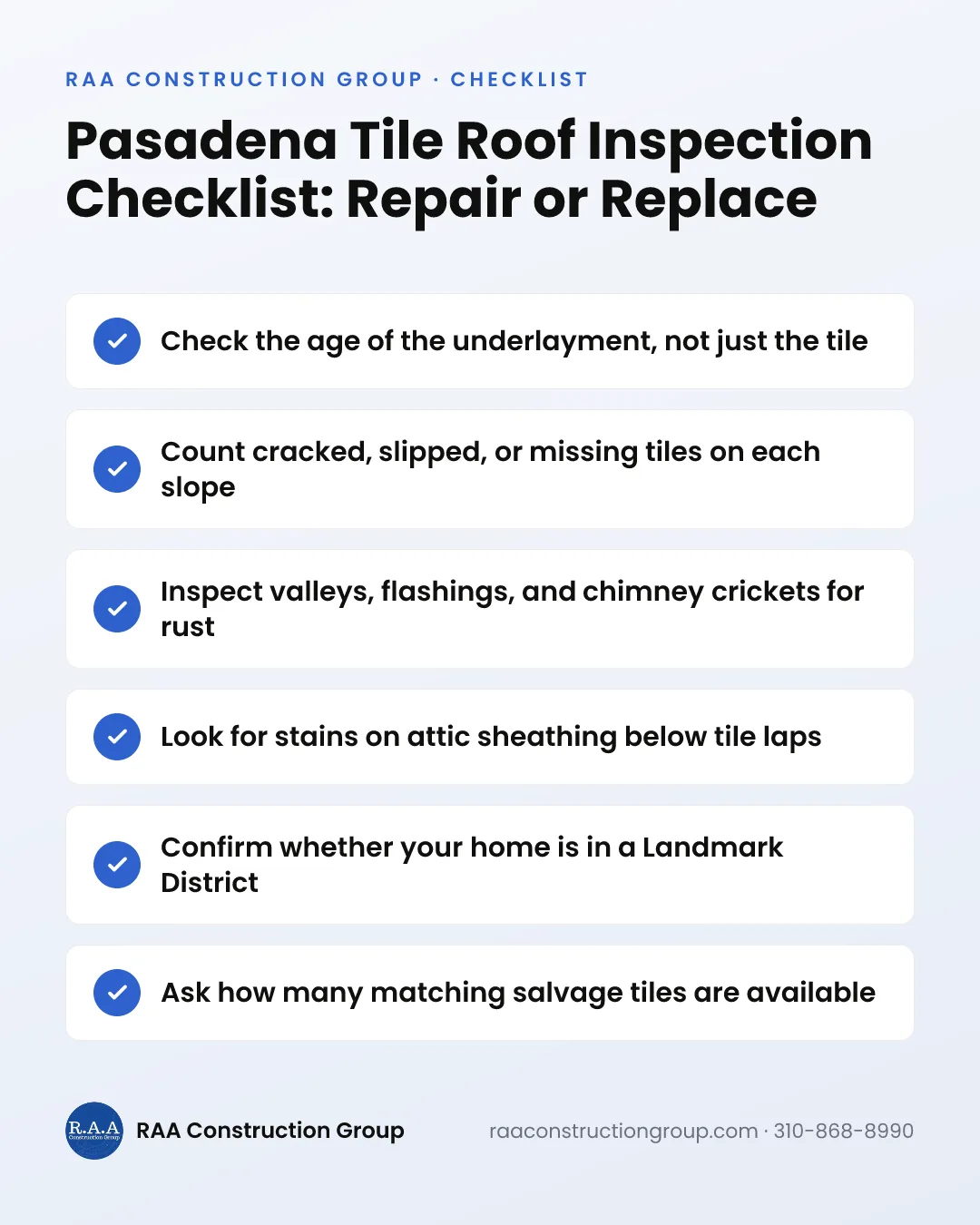
Inspection Checklist Before You Decide
Before you commit to a repair or a new roof, get clear answers to these questions. A good inspection includes lifting tiles in several places, not just looking from a ladder.
- How old is the underlayment, and what condition is it in where tiles were lifted?
- What share of the tile is cracked, slipped, or previously patched?
- Are valleys, flashings, and penetrations original, and are any rusted?
- Is there rot in battens, fascia, or roof deck at the eaves?
- Is the property a designated landmark, in a Landmark District, or in a fire hazard zone?
- Is enough matching salvage tile available, or will new tile be needed?
As a licensed California contractor (CSLB #1047380) with more than 15 years in business, we document these findings in writing with photos so you see what we saw. Every project comes with a fixed-price proposal and our one-year workmanship warranty. You can schedule a free on-site roof inspection or read more about our roofing and waterproofing services.
Find Out What Your Tile Roof Actually Needs
Get a free on-site inspection with photos and a fixed-price proposal for repair, relay, or replacement. Call 310-868-8990 or book online.
Schedule a Free EstimateFAQ